
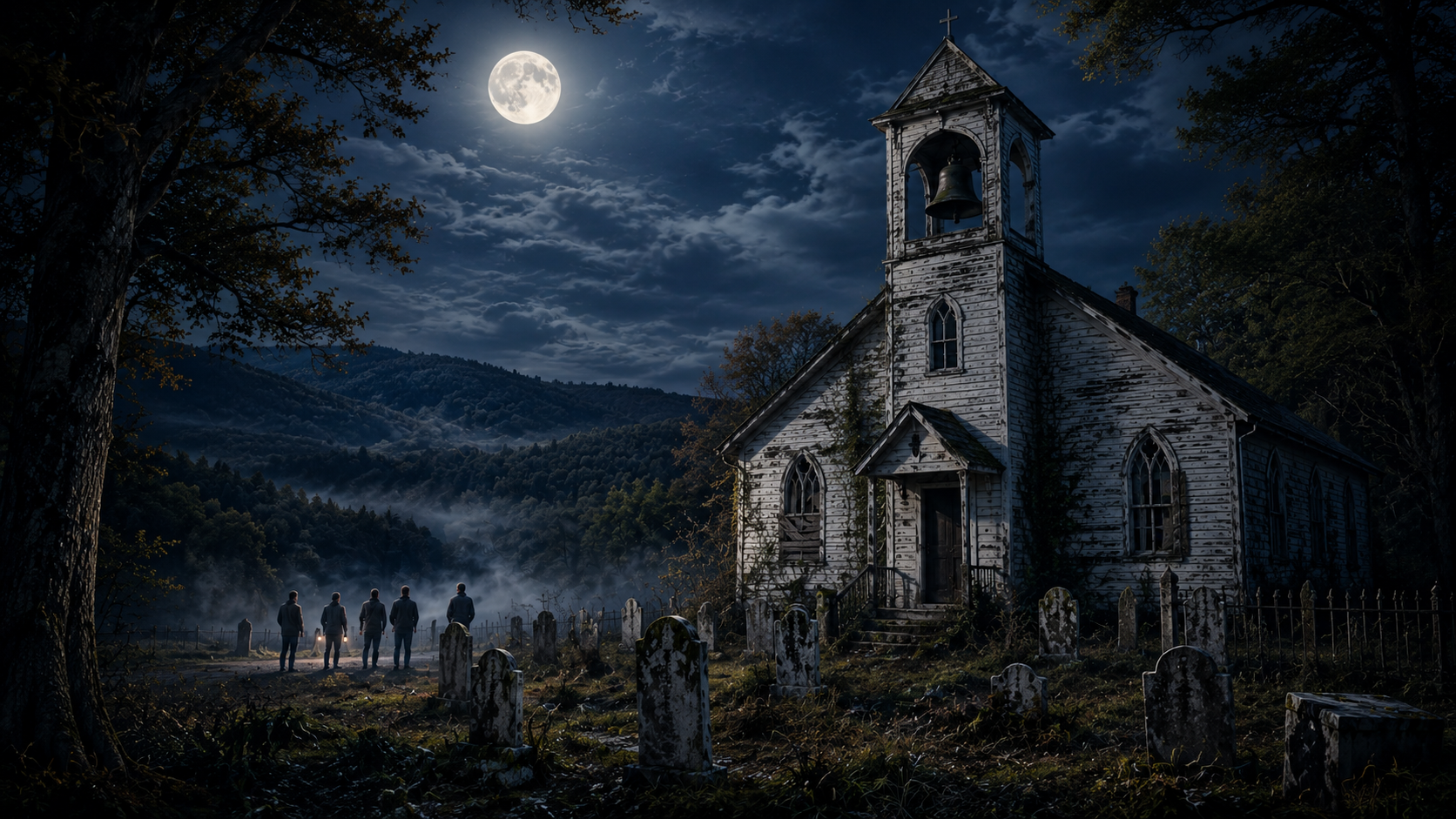
The Bell That Rang After Midnight
The first time I heard that old church bell, I blamed my neighbor's mule.
That may sound foolish now, but when you grow up in the hills, you learn that just about every strange noise has a perfectly ordinary explanation waiting behind it. A loose sheet of tin can howl like a woman in mourning. A barred owl can sound enough like a crying baby to make a grown man grab a shotgun before he grabs his glasses. Even an old mule with arthritis and a disagreeable disposition can let out a bray that echoes off the ridges in ways that'll make the hair stand up on the back of your neck.
So, when that deep bronze note rolled across the valley a little after midnight, I pulled the quilt over my shoulder, grumbled something unfit for Sunday company, and figured somebody's livestock had found another creative way to rob me of sleep.
Then it rang again.
Not loud.
Not frantic.
Just one slow, deliberate toll that drifted across the darkness with a richness you could almost feel in your chest.
The sound seemed too heavy for the quiet mountain air. It floated over the creek, climbed the cedar-covered hills, slipped through the cracked window above my bed, and settled somewhere deep inside my memory.
I opened one eye.
My wife, Martha, was already awake.
"You hear that?" she whispered.
"I heard something."
"That was the church bell."
"There ain't been a church bell in thirty years."
She looked at me the way only a woman married for four decades can look at a stubborn husband.
"Still sounded like one."
Neither of us said another word.
We waited.
Nothing.
Outside, katydids sang without interruption. A whip-poor-will called somewhere down by Miller Creek. Leaves rustled beneath a faint breeze carrying the smell of pine needles and damp earth through the screen window.
Then...
Dong.
One solitary note.
Martha quietly crossed herself.
I laughed.
Not because I wasn't unsettled, but because nervous laughter has probably saved more country men from admitting fear than courage ever has.
"Probably kids," I muttered.
"Kids don't ring bells that ain't connected to anything."
That statement lingered longer than either of us wanted.
The old St. Bartholomew Church had stood on Hollow Ridge since before the Civil War. By the time I was born, the congregation had already moved into a larger brick church closer to town, leaving the original white clapboard building abandoned beneath towering oaks.
As children, we'd dared each other to touch its weathered front door.
As teenagers, we'd parked nearby hoping ghosts appreciated young romance enough to leave us alone.
As adults, we mostly ignored it.
The building simply became another familiar landmark tucked between memories and overgrown blackberry vines.
Everybody knew about the bell.
Just as everybody knew it couldn't ring.
The bronze bell still hung inside the leaning wooden tower, blackened with age and streaked green where rain had worked against the metal for more than a century. But sometime back in the late nineteen-sixties, the thick hemp rope had rotted away. Folks talked about replacing it until termites weakened the staircase leading into the bell tower. Eventually county inspectors declared the building unsafe, locked the doors with heavy chains, and nailed plywood over the rear entrance.
Nobody had climbed to that bell in decades.
Nobody legally could.
By breakfast the next morning, half the town had already heard the story.
That may surprise folks unfamiliar with country life, but gossip in a small Appalachian valley moves faster than fiber optic internet. Before coffee finished dripping at Harlan's General Store, every stool around the cracker barrel carried a different version of what had happened.
"It was kids."
"No, it was hunters."
"Probably somebody fooling with a loudspeaker."
"My cousin heard it too."
"My dogs barked half the night."
Old Earl McKinney stirred sugar into coffee that probably had more spoon marks than actual flavor.
"Ain't the first time."
That quieted everybody.
Earl wasn't a man given to storytelling. He'd fought in Korea, survived two heart attacks, buried one wife, and repaired tractors until arthritis bent his fingers into permanent hooks. If Earl volunteered information without being asked, folks tended to listen.
"What do you mean?" I asked.
He stared into his cup before answering.
"Heard it in nineteen eighty-three."
Several heads turned.
"Same bell?"
He nodded.
"Middle of the night?"
Another nod.
"What happened?"
"Nothin'."
He shrugged.
"Bell rang three times. Sheriff checked the church. Doors were still locked."
Someone chuckled.
"You dreamt it."
Earl slowly raised his eyes.
"I know the difference between sleeping and standing barefoot on my porch."
Nobody challenged him after that.
Silence settled over the store except for the soft humming of refrigerators and the steady ticking of the old Coca-Cola clock hanging above the bait cooler.
Finally, Harlan himself spoke.
"My granddaddy used to say the bell rang whenever somebody forgot what happened up there."
Nobody laughed.
Harlan's grandfather had been the unofficial historian of our county. He remembered names, dates, births, floods, and funerals better than courthouse records. If he claimed an old saying existed, chances were it did.
"What happened?" someone finally asked.
Harlan rubbed the edge of the counter with an old towel.
"Never would tell me."
That answer only made matters worse.
By lunchtime, forgotten stories suddenly became remembered facts. Folks recalled hearing grandparents mention funerals with no bodies. Others claimed Confederate deserters hid near the church. Somebody insisted a preacher disappeared without explanation sometime around 1870.
Every conversation ended the same way.
"I don't rightly know if it's true..."
Those six words have probably launched more legends than any history book ever printed.
Three nights later, the bell rang again.
This time nearly everyone heard it.
Deputy Frank Collins happened to be parked beside the volunteer fire station finishing paperwork inside his patrol truck when the first toll echoed across the valley. He later swore the windows vibrated.
Across town, Linda Patterson was closing the register inside the pharmacy when customers stopped talking and turned toward the front windows.
The Jenkins brothers, catfishing along Miller Creek, thought someone was playing a prank until the sound rolled over the water a second time.
Even old Miss Eloise, nearly ninety-three and hard of hearing enough to keep her television loud enough for neighboring counties to enjoy, called her daughter the following morning.
"I heard the church."
That statement alone convinced half the skeptics.
Deputy Collins wasted no time driving to Hollow Ridge.
Several curious residents followed despite his attempts to discourage them. By the time headlights climbed the narrow gravel road leading toward St. Bartholomew, nearly a dozen pickups sat bumper to bumper beneath the trees.
Nobody spoke above a whisper.
Moonlight filtered through ancient branches, casting long silver shadows across weathered gravestones leaning at impossible angles. Moss climbed over cracked marble markers whose names had softened beneath generations of rain. The church itself stood exactly as it always had, lonely against the ridge, its white paint peeling away in broad curls that revealed gray timber beneath.
The heavy chain still wrapped around the front doors.
The county lock remained closed.
Every window remained boarded.
No fresh footprints crossed the damp ground surrounding the building.
Deputy Collins walked the perimeter with two powerful flashlights sweeping every inch of the churchyard. He checked beneath the porch, behind the foundation stones, inside nearby brush, and even crawled beneath the sagging structure despite muttering colorful opinions about copperheads.
Nothing.
No ladders.
No climbing gear.
No hidden speakers.
No evidence that another living soul had been anywhere near the building.
As the group gathered near the front steps, someone suggested they simply wait.
Perhaps whoever had played the trick would return.
Perhaps the bell would ring again.
The forest settled around them with that peculiar stillness found only after midnight, when even insects seem to pause long enough to listen. A faint breeze carried the scent of wild honeysuckle through the old cemetery, stirring weeds that had claimed forgotten graves. Somewhere far off, a coyote barked once before silence folded back across Hollow Ridge.
Then, from somewhere high above the locked church, the ancient bell gave a single slow, mournful toll.
Every flashlight swung upward at the same moment.
The tower windows remained empty.
Nothing moved.
Nothing could be seen except darkness where the bell hung suspended inside the abandoned belfry.
And yet the sound continued to vibrate through the night air long after the bronze itself should have fallen silent.
For the better part of a week, Hollow Ridge talked about little else.
That is the curious thing about an unexplained event in a small town. The mystery itself seldom changes, but the people surrounding it do. Skeptics begin entertaining possibilities they once dismissed without hesitation, believers become even more convinced, and those who honestly do not know where they stand spend their evenings listening more carefully to the darkness than they ever have before.
I counted myself among that last group.
I have always preferred facts over fancy. Years spent repairing engines taught me that every strange rattle eventually comes from a loose bolt, every mysterious leak has a cracked gasket somewhere, and every machine that refuses to behave is simply waiting for somebody patient enough to understand it. Ghosts never fixed a transmission, and spirits never fouled a spark plug.
Still, machines obey rules.
That bell did not.
The following Saturday morning found me climbing the hill toward St. Bartholomew alongside Deputy Collins, Earl McKinney, Harlan, and two county maintenance men carrying enough tools to rebuild half the church if necessary. The sheriff had finally granted permission to cut the rusted chain and conduct a thorough inspection inside the building.
Morning sunlight filtered through the oaks, scattering golden patches across the abandoned churchyard. Dew still clung to waist-high grass surrounding crooked gravestones whose inscriptions had nearly surrendered to time. A pair of crows complained loudly from the bell tower as though offended by our intrusion, then lifted into the cool mountain air with heavy wingbeats.
Frank slipped bolt cutters around the chain.
The first squeeze barely dented the corroded links.
The second sent a sharp metallic crack echoing through the cemetery.
The chain fell away with surprising weight.
Nobody rushed inside.
Instead, we stood quietly for several moments staring at the weathered double doors. The faded paint had blistered into curling flakes, while iron hinges carried thick scales of rust. Cobwebs stretched between the handles and the doorframe, untouched except where the chain had pressed against them for years.
"If somebody's been using this place," Earl muttered, "they've learned how to put spiderwebs back."
Nobody smiled.
Frank eased one door inward.
The hinges groaned like an old oak bending in a winter wind.
The smell reached us first.
Not decay.
Age.
Dry pine boards, old hymnals, dust, candle wax, mouse nests, damp stone, and that unmistakable scent every forgotten building seems to develop after generations without regular footsteps. Sunlight poured through gaps in broken shutters, revealing thousands of dust particles drifting lazily through the sanctuary like tiny floating stars.
Rows of handcrafted pews remained exactly where the last congregation had left them.
Several had collapsed beneath their own weight.
Others leaned awkwardly after one leg finally surrendered to rot.
The pulpit still stood at the front beneath a large wooden cross darkened by decades of smoke from kerosene lamps. A cracked Bible rested open exactly where someone had abandoned it years before, its brittle pages curled along the edges.
Harlan stepped carefully down the center aisle.
"I haven't been in here since I was ten."
His voice sounded strangely small beneath the high wooden ceiling.
"You remember anything?"
"My grandmother singing."
He smiled faintly.
"And getting fussed at for carving my initials under a pew."
Sure enough, a few minutes later he found them.
A childish H.M. scratched unevenly into the underside of the third bench.
"They whipped me for that."
"I reckon they didn't whip hard enough," Earl answered with a grin.
The joke loosened everyone's nerves.
For the next hour we inspected every inch of the sanctuary.
No hidden wires.
No batteries.
No speakers.
No recent footprints except those we were making ourselves.
The floor held a thick blanket of undisturbed dust that recorded every step with perfect clarity. Mouse tracks crossed beneath several pews. A raccoon had apparently spent part of the previous winter in the choir loft. Swallows had built nests near the rafters.
Nothing suggested human visitors.
The maintenance crew finally turned their attention to the bell tower.
The staircase looked worse than anyone expected.
Several treads had completely disappeared, leaving jagged gaps between weathered beams. Others sagged enough to make your stomach tighten just looking at them. One fellow suggested climbing anyway until Earl gave him a look usually reserved for men attempting to pet rattlesnakes.
"You first."
The county men wisely reconsidered.
Instead, they brought in a long extension ladder from one of the trucks.
After carefully securing it inside the sanctuary, Frank volunteered to climb.
"I've made dumber decisions."
"You've made plenty," Harlan replied.
Frank laughed.
"That's encouraging."
Every rung groaned beneath his boots.
Halfway up he stopped long enough to shine a flashlight around the upper chamber.
"Dust everywhere."
He climbed another six feet.
"I can see the bell."
"What about the rope?"
"Ain't one."
"Anything tied to it?"
"Nope."
"What about wires?"
He swept the flashlight slowly around the interior.
"Nothing."
Frank finally reached the platform beneath the bell and disappeared. We listened to the scrape of boots against old timber while pigeons fluttered somewhere above.
After several minutes his voice drifted downward.
"Y'all better come look."
One at a time we climbed just high enough to see into the tower.
The bell itself was magnificent.
Nearly four feet tall, cast from bronze so old its surface resembled weathered leather more than polished metal. Decorative vines circled its shoulder beneath a Latin inscription few of us could read. The iron yoke supporting its weight remained solid despite obvious age.
More importantly, the clapper hung perfectly still.
No rope.
No chain.
No mechanism.
Nothing connected to it except gravity.
Frank placed one hand against the bronze.
"It's cold."
"So?"
"I don't know."
He frowned.
"It just feels...cold."
I reached up myself.
He was right.
The sanctuary below had grown warm beneath the late morning sun, yet the bell felt almost icy beneath my fingertips, as though it had been sitting in deep shade on a January morning instead of inside a stuffy wooden tower.
"Maybe bronze holds temperature different," one of the county men offered.
"Maybe."
Nobody sounded convinced.
Frank examined every bolt, every support beam, every inch of surrounding timber.
Finally, he looked downward.
"If this thing rang by itself..."
He stopped.
"What?"
He shook his head.
"It would've had to swing."
"Obviously."
"It can't."
He pointed toward the heavy wooden frame.
"The clearance between the bell and the tower walls is barely three inches."
He demonstrated by pushing gently against the bronze.
The massive bell barely moved.
Even using both hands, he managed only a slight rocking motion before the clapper softly tapped the inside.
Tink.
The tiny sound scarcely carried beyond the tower.
To produce the deep rolling tone, we'd all heard across the valley, the bell would need to swing dramatically.
There simply wasn't room.
We climbed back down without saying much.
Outside, sunlight had chased away the morning chill. Cicadas hummed from the surrounding woods while butterflies drifted among patches of Queen Anne's lace growing beside forgotten graves. It seemed impossible that such an ordinary summer afternoon existed in the same place that had unsettled an entire community only nights before.
As we packed equipment into the trucks, an elderly pickup eased slowly through the cemetery gate.
Behind the wheel sat Miss Eleanor Whitfield.
Everyone knew Miss Eleanor.
She had turned ninety the previous spring and still insisted on driving herself anywhere within twenty miles, despite the town's repeated attempts to convince her otherwise. Her snow-white hair was tucked beneath a faded blue hat decorated with artificial daisies, and her sharp gray eyes missed very little.
She climbed carefully from the truck using a polished hickory cane.
"I heard y'all finally opened the church."
Frank nodded.
"Didn't find much."
"I figured."
She looked toward the tower.
"My daddy warned me this day would come."
That statement captured everyone's attention.
"What did he mean?" Harlan asked.
She smiled gently.
"He said folks eventually forget."
"Forget what?"
"The reason they stopped ringing that bell."
No one interrupted her.
She rested both hands atop the cane and gazed across the weathered cemetery as though searching for faces hidden beneath the stones.
"When I was a little girl, my grandmother told me the church quit using that bell before the congregation ever moved away. Folks always assumed it was because the rope wore out."
She slowly shook her head.
"That wasn't the reason."
"What was?"
Miss Eleanor drew a slow breath.
"They buried too many children."
The breeze seemed to disappear.
Even the cicadas fell strangely quiet.
She continued in the calm voice of someone repeating a memory entrusted to her long ago.
"There was sickness here. Bad sickness. One summer the cemetery filled faster than the preacher could read Scripture. Every time that bell rang, another family knew they were about to walk behind a wagon carrying somebody they loved."
She paused, her eyes lingering on the oldest section of graves where marble markers leaned together beneath sprawling oak roots.
"My grandmother said the sound finally became more frightening than comforting. Mothers started crying whenever they heard it. Children covered their ears. The elders decided enough sorrow had echoed through these hills."
"And the rope?" Earl asked quietly.
"They removed it themselves."
She looked directly at the bell tower.
"They said the valley needed silence more than another funeral."
No one spoke for several long moments.
The church suddenly seemed much older than it had an hour earlier.
Not abandoned.
Remembering.
Late that evening, as the sun slipped behind the western ridges and long shadows stretched across Hollow Ridge, I found myself sitting on my front porch with a cup of coffee that had gone cold without my noticing. The valley settled into its familiar nighttime rhythm as tree frogs began their chorus and fireflies drifted above the pasture like floating embers.
Around eleven-thirty, headlights appeared on the road below.
Another truck.
Then another.
Without anyone organizing it, people from town had begun parking where they could see the old church.
Nobody wanted to admit they were waiting.
Everyone was.
At exactly twelve minutes after midnight, before a single person had spoken above a whisper, the ancient bell gave two slow, resonant tolls that rolled across the sleeping valley.
This time, every witness was already looking directly at the dark silhouette of the bell tower.
No one saw anything move.
The sound of those two midnight tolls lingered over Hollow Ridge long after the echoes themselves had faded. Nobody rushed toward the church this time. It was as though every soul gathered along the roadside had silently agreed that whatever had happened would not be solved by another frantic search with flashlights and good intentions. Instead, truck doors closed softly, engines started one by one, and taillights disappeared into the darkness without a word.
By sunrise, however, curiosity had regained the upper hand.
The diner filled earlier than usual. Coffee flowed freely, biscuits disappeared almost as quickly as Martha could bake them, and every table carried its own version of the previous night's events. The remarkable thing was not that everyone agreed they had heard the bell. It was that every description sounded nearly identical.
"It rang twice."
"Slow."
"Didn't sound cracked."
"Sounded...full."
That last word surfaced again and again.
Old bells that have weathered two centuries generally develop imperfections. Their voices change. Hairline fractures alter their tone. Metal fatigues. Yet everyone insisted the bell had sounded rich and complete, as though it had just been cast by the foundry instead of surviving generations of weather, neglect, and changing seasons.
Around midmorning, the town librarian called Harlan's store asking if anyone wanted to examine several boxes of church records she'd discovered in the courthouse basement.
Within an hour, the five of us found ourselves standing around a scarred oak table inside the library's local history room.
The place smelled exactly the way an old library ought to smell.
Leather.
Paper.
Dust.
Furniture polish.
A faint hint of mildew.
Sunlight streamed through tall windows, illuminating shelves crowded with county histories, family genealogies, faded plat maps, military records, and brittle newspapers whose edges had turned the color of dried tobacco leaves.
Mrs. Grayson, the librarian, gently placed three wooden archive boxes before us.
"I don't think anyone has opened these in years."
"What's in them?" Frank asked.
"Church ledgers, correspondence, financial books, funeral records, and whatever else someone decided to save."
She carefully unfolded a pair of cotton gloves before lifting the lid from the first box.
The oldest ledger dated back to 1841.
Each page had been written with remarkable penmanship, the dark ink only slightly faded after nearly two centuries. Births. Baptisms. Weddings. Donations of livestock. Repairs to the church roof. Purchases of lamp oil and hymnals. The everyday rhythm of a mountain congregation unfolded page after page in neat, deliberate handwriting.
Nothing unusual appeared until we reached the summer of 1873.
The entries abruptly changed.
Attendance dropped.
Several funerals occurred within days of one another.
Entire families appeared repeatedly.
The minister's handwriting became noticeably less steady.
One page contained nothing but names.
Twenty-three of them.
All children.
Mrs. Grayson quietly removed her glasses.
"My goodness."
No one spoke.
Beside each child's name was a date.
Nearly all fell within six weeks.
There was no explanation.
No mention of disease.
No description of circumstances.
Only names.
Ages.
Dates.
The silence inside the history room became almost unbearable.
Finally, Earl spoke.
"My grandmother mentioned scarlet fever once."
Mrs. Grayson slowly shook her head.
"I don't believe it was scarlet fever."
She disappeared into another aisle before returning with a thick county history published in the 1930s.
Turning several pages, she found a brief passage scarcely longer than a paragraph.
"In the summer of 1873," she read quietly, "a severe outbreak of mountain fever struck settlements surrounding Hollow Ridge. Contemporary accounts differ regarding its exact nature. Many victims were children. Services continued at St. Bartholomew Church until the congregation temporarily suspended regular meetings."
"Mountain fever?" Harlan asked.
"That's all it says."
"No explanation?"
She shook her head.
"Nothing."
Frank continued turning pages in the church ledger.
Near the back, folded between two entries, he discovered a single loose sheet.
Its edges had become brittle with age.
The handwriting differed from everything else in the collection.
This script appeared hurried.
Almost desperate.
He carefully read aloud.
"The bell has become a sorrow unto the people. Every toll brings dread before comfort. We have agreed that until happier days return, the rope shall be removed. Let prayer gather us instead of grief."
No signature appeared beneath the statement.
Only the date.
September 4, 1873.
We all looked at one another.
Miss Eleanor's story had been true.
Nobody had forgotten because it never happened.
They had forgotten because time eventually buries even painful decisions beneath ordinary life.
The librarian carefully placed the page inside a protective sleeve.
"It sounds almost compassionate."
"It does," Martha said softly.
"Imagine hearing that bell every time another child died."
No one had to imagine very hard.
That afternoon, Frank contacted the state historical society hoping additional records might explain the epidemic. While waiting for a response, several of us returned to the church with cameras, measuring tapes, and enough equipment to satisfy even the most determined skeptic.
This investigation proved more methodical than the first.
Every doorway was measured.
Every window photographed.
The tower dimensions were recorded.
The bell itself received close inspection from an engineer who happened to live two counties over and volunteered after reading about the mystery in the regional newspaper.
His name was Dr. Samuel Keating.
He specialized in structural engineering and possessed the sort of quiet confidence that comes from solving difficult problems for a living.
After nearly three hours examining the bell, its supports, and the surrounding framework, he climbed down the ladder wearing a thoughtful expression.
"What do you think?" Frank asked.
"I can tell you several things."
He brushed dust from his sleeves.
"The bell is genuine."
"We figured."
"It weighs somewhere between twelve and fourteen hundred pounds."
"That much?"
"Easily."
He glanced toward the tower.
"More importantly, the supporting structure has shifted over the years."
"What does that mean?"
"It means the bell has even less room to move now than when it was installed."
He unfolded a small notebook.
"To produce the volume described by your witnesses, the bell would require significant oscillation. Based on available clearance..."
He paused.
"It physically cannot swing far enough."
"What if somebody struck it with a hammer?" someone suggested.
He considered the idea.
"You would need to reach it first."
"Fair."
"And even then, the resulting tone would differ noticeably."
"Different how?"
He smiled faintly.
"Imagine tapping a crystal wineglass with a spoon versus ringing it properly."
"So?"
"The sound everyone describes is that of a fully ringing bell."
He closed the notebook.
"I cannot explain how that occurred."
Those words carried unusual weight.
Experts are accustomed to offering explanations.
When they openly admit they do not have one, people tend to remember.
News of Dr. Keating's conclusions spread quickly through neighboring counties.
Within another week, reporters began arriving.
Most stayed only long enough to gather colorful interviews before moving on to the next curiosity.
One television crew filmed the church during daylight, interviewed Miss Eleanor beside the cemetery gate, and confidently suggested unusual wind currents might somehow activate the bell.
That theory lasted exactly one evening.
Meteorologists confirmed the valley had experienced perfectly calm conditions on every reported night.
Another expert proposed thermal expansion of the metal.
An acoustics professor politely dismissed the idea within hours.
Someone else suggested elaborate pranksters.
Deputy Collins invited them to explain how pranksters repeatedly entered and exited a locked church without disturbing dust, spiderwebs, or a single footprint.
No satisfactory answer emerged.
Autumn quietly arrived.
Maple leaves turned brilliant shades of crimson and gold while cool mornings carried the scent of woodsmoke drifting from farmhouse chimneys. The mystery gradually settled into the background of daily life. Folks still mentioned it occasionally, but conversations increasingly returned to harvests, football games, deer season, and whether Earl's ancient tractor would finally refuse to start.
For nearly six weeks, the bell remained silent.
Some declared the excitement over.
Others seemed almost disappointed.
Then, on the evening before All Saints' Day, Miss Eleanor passed away peacefully in her sleep.
She was ninety years old.
The entire county attended her funeral.
She had taught three generations of children, delivered countless church suppers, organized quilting circles, remembered every birthday worth remembering, and somehow managed to know everyone's grandparents by their first names.
Her service took place in the newer brick church downtown.
Afterward, family and friends followed the hearse to the old cemetery at St. Bartholomew, where six pallbearers carried her casket beneath towering oaks whose leaves drifted gently through the cool afternoon air.
No one mentioned the bell.
There seemed no reason to.
As the minister finished the final prayer and the last "Amen" faded into the stillness, every head remained respectfully bowed.
That was when the ancient bronze bell rang once.
Not loudly.
Not violently.
Just one deep, solemn note that rolled across Hollow Ridge with unmistakable clarity.
Every person present heard it.
More than two hundred mourners slowly lifted their eyes toward the weathered bell tower.
The autumn air remained perfectly still.
No breeze stirred the flags.
No bird flew from the roof.
Nothing moved.
Yet the echo lingered among the hills as though the valley itself had answered the farewell.
No one ran.
No one screamed.
Several people quietly wept.
Even Deputy Collins removed his hat.
And for reasons I still cannot fully explain, not a single person present seemed frightened.
Long after Miss Eleanor's funeral, people continued speaking about that single toll in hushed voices, not because it frightened them, but because it seemed to belong exactly where it had happened. Even those who spent their lives dismissing ghost stories found themselves struggling to explain why the sound had felt less like an interruption and more like the closing sentence of a conversation that had begun generations earlier. Nobody claimed to have seen an apparition standing beside the bell tower. Nobody reported mysterious lights drifting through the cemetery or shadowy figures among the graves. There had only been the bell, the silence that followed it, and the uncomfortable realization that every person present had experienced the same moment in precisely the same way.
Winter settled over Hollow Ridge with an early frost.
The abandoned church looked older beneath bare limbs than it ever had surrounded by summer leaves. Every knot in its weathered siding stood out against the pale mornings, and every missing shingle seemed to announce another year surrendered to time. Snow never lingered long in our valley, but several cold rains darkened the clapboards until the building resembled an old photograph whose edges had begun fading into memory.
I found myself stopping there more often than I intended.
Sometimes I parked beside the rusted cemetery gate after finishing errands in town. Other days I carried a thermos of coffee and simply sat watching the church while crows hopped among the gravestones. There was nothing especially remarkable about the place during daylight. Squirrels chased one another across the roof. Wind occasionally rattled loose shutters. Moss climbed patiently over limestone markers whose inscriptions could no longer be read without tracing the letters by hand.
The mystery only returned after sunset.
Deputy Collins admitted he had begun keeping a notebook.
Every report of the bell received its own page.
Date.
Time.
Weather conditions.
Moon phase.
Witnesses.
Direction from which the sound appeared to travel.
His records soon revealed an interesting pattern.
The bell never rang randomly.
It rang only a handful of times each year.
Always after midnight.
Never during storms.
Never during high winds.
Never more than three tolls in a single night.
The intervals between occurrences varied so widely that no practical schedule emerged. One year might pass with only two reported incidents, while another saw five within a matter of months. Whatever governed those lonely midnight notes, it ignored calendars and human expectations alike.
One January afternoon Frank invited me to review the notebook.
"I need another pair of eyes."
"For what?"
"I keep thinking I'm missing something."
We spread his notes across the dining room table at his house while his wife kept our coffee cups full. Maps of the valley lay beside weather reports, newspaper clippings, engineering sketches, and copies of the old church ledger. It looked less like a sheriff's investigation than a historian's life's work.
He tapped one page.
"Look at the witnesses."
I scanned the names.
Families.
Hunters.
Travelers.
Delivery drivers.
Teachers.
Retirees.
Teenagers.
"Eighty-three people altogether."
"So?"
"They don't agree on much."
He leaned back.
"They disagree about politics, football, barbecue, fishing holes, and where to buy tractor parts."
I laughed.
"That's true enough."
"But every single one describes the bell exactly the same way."
He handed me another page.
"I've interviewed each of them separately."
Every description echoed the others.
Deep.
Clear.
Slow.
Mournful.
Impossible to determine exactly where the sound originated, despite everyone believing it came from the church.
"No one says it echoed strangely," Frank continued.
"No."
"No one describes a cracked tone."
I shook my head.
"No."
"And nobody hears it differently."
He folded his arms.
"If this were imagination, I'd expect imagination to vary."
Instead, it hadn't.
The consistency bothered him more than the mystery itself.
Several months later the state historical society completed its research into St. Bartholomew.
Boxes of forgotten documents surfaced from church archives in another county, along with letters exchanged between ministers during the nineteenth century. Most discussed ordinary matters, repairs to wagon roads, shortages of hymnals, requests for visiting preachers, but one letter immediately caught everyone's attention.
It had been written in November of 1873 by Reverend Isaiah Mercer, only weeks after the rope had been removed.
The letter read in part:
"Our people have suffered beyond language. I cannot pretend to understand why such grief visited this valley. The bell that once gathered us for worship became the sound every mother dreaded. We have laid aside the rope, hoping memory itself may one day grow gentler. Yet I pray that should future generations hear that bell again, they remember not fear alone, but those whose names deserve never to vanish."
The words spread quietly through town.
Unlike rumors, they required no embellishment.
They already carried enough weight.
One Saturday morning volunteers gathered to clean the cemetery.
It began as a modest community project and grew into something much larger. Teenagers trimmed briars that had swallowed forgotten headstones. Local veterans repaired broken fencing along the western edge of the property. Garden clubs planted bulbs near the entrance. Scouts documented inscriptions before erosion erased them forever. Families who had not visited ancestral graves in years found themselves brushing moss from names they had nearly forgotten.
I spent most of that day beside Earl.
Despite his aching hands, he insisted on resetting several leaning markers.
"Funny thing about graveyards," he said while tamping fresh soil around one stone.
"What's that?"
"They ain't really for the dead."
"No?"
He rested both palms atop the shovel.
"They're for reminding the living."
I looked across the hillside.
Children laughed while gathering fallen branches.
Neighbors shared sandwiches from the tailgates of pickup trucks.
Someone passed around homemade peach cobbler.
Life filled the same ground where unimaginable sorrow had once settled.
"I reckon you're right."
He nodded toward a tiny weathered marker barely taller than his boot.
"Somebody loved every one of these people."
That simple sentence stayed with me.
As spring returned, wild violets bloomed between the oldest graves, softening the cemetery with patches of purple and white. Dogwoods flowered beneath the bell tower, their blossoms glowing against the dark timber of the abandoned church. The building still leaned slightly, and the paint continued peeling away in thin curls, yet somehow it no longer appeared neglected.
It appeared remembered.
Years passed.
Deputy Collins eventually retired.
Harlan's grandson took over the general store.
Earl left us one quiet November morning after ninety-one hardworking years, and we buried him beneath a cedar overlooking Miller Creek. Martha's hair turned silver. Mine disappeared almost entirely. Knees complained louder each winter, and coffee somehow tasted better every passing year.
The church remained.
So did the bell.
Every now and then, someone new would move into the valley and hear the story for the first time. Usually, they smiled politely. A few chuckled outright. Several announced they intended to solve the mystery once and for all.
They all came away with the same answer.
None.
The building continued to defy every reasonable explanation.
Engineers examined it.
Historians documented it.
Acoustics specialists studied it.
Paranormal investigators spent long nights recording silence.
They left with hard drives full of crickets, wind through bare branches, distant coyotes, and one shared conclusion.
No one could explain the bell.
I am an old man now.
When sleep refuses to cooperate, I sometimes sit on my porch wrapped in an old wool blanket while the valley settles into darkness. The creek still murmurs over the same stones it did when I was a boy. Whip-poor-wills still call from the ridges on warm nights. Fireflies still drift lazily across the pasture every June as though tiny lanterns are searching for something only, they can see.
Every so often, usually years apart, the midnight stillness breaks.
One deep bronze note rolls across Hollow Ridge.
Then silence returns.
I no longer reach for a flashlight.
I no longer climb into my truck.
I no longer try to invent explanations sturdy enough to satisfy the part of me that always wanted every mystery solved.
Some things deserve investigation.
Others deserve preservation.
Whether that bell truly rings by some forgotten force of nature, by an acoustic phenomenon no scientist has yet identified, or by something beyond our present understanding, I cannot honestly say. I have heard it with my own ears. I have stood beneath the silent tower moments afterward. I have placed my hand upon the cold bronze where no rope has hung for more than a century, and I have found nothing capable of producing the sound that so many witnesses have described.
What remains is not proof of the supernatural.
It is something both simpler and more enduring.
An unanswered question carried across generations.
Perhaps that is why the story refuses to disappear.
The abandoned church still stands on Hollow Ridge, watching over names nearly erased by rain and time. The old bell still hangs in its weathered tower, motionless beneath ancient beams. And somewhere, in the quiet hours after midnight, when the valley is wrapped in darkness and memory feels closer than daylight, there are those who still awaken to the slow, solemn voice of a bell that should have fallen silent long ago.