The Night the Door Stayed Open
There is a kind of fear that does not arrive loudly. It does not slam doors or echo through the dark. It does not need to. Instead, it settles quietly into the edges of a room, into the spaces between light and shadow, into the small moments when everything feels just slightly off. It waits there, patient and certain, knowing that it does not have to prove itself. Some part of you already understands that it is real.
For Eli, it always began with the door.
Every night, before he allowed himself to rest, he checked it. Not casually, not out of routine, but with intention. The closet door had to be closed completely. The bedroom door, however, was left slightly open, just enough for the hallway light to stretch across the floor and reach the edge of his bed. That thin line of light was not comfort in the way most people would think. It was not about feeling safe. It was about control. As long as that light stayed steady and unchanged, the world remained predictable. The hallway was just a hallway. The house was just a house. Nothing was hiding. Nothing was waiting.
That belief held, night after night, until the moment it didn’t.
The change was subtle. That was what made it unsettling. There was no sound to mark it, no movement to explain it. The light beneath the door simply shifted. It dimmed slightly, not enough to disappear, but enough to feel wrong. Enough to stand out to someone who was paying attention. And Eli always paid attention.
He sat up in bed, staring at that thin line of light as if it might correct itself under observation. For a moment, he told himself it was nothing. A passing shadow. A trick of tired eyes. Something ordinary that would make sense if he gave it time. But time did not fix it. The light remained uneven, strained, as though something unseen had stepped into its path and decided not to move.
The feeling came slowly, settling into him before he could name it. It was not panic, not yet. It was quieter than that. A tightening in his chest, a subtle weight pressing inward, a quiet suggestion that something had changed and that he should pay attention. A week ago, that feeling would have been enough. He would have turned away, pulled the covers up, and let the darkness exist somewhere beyond his awareness. That had always been the rule. If you did not look at it, it could not become something worse.
But that was before the club.
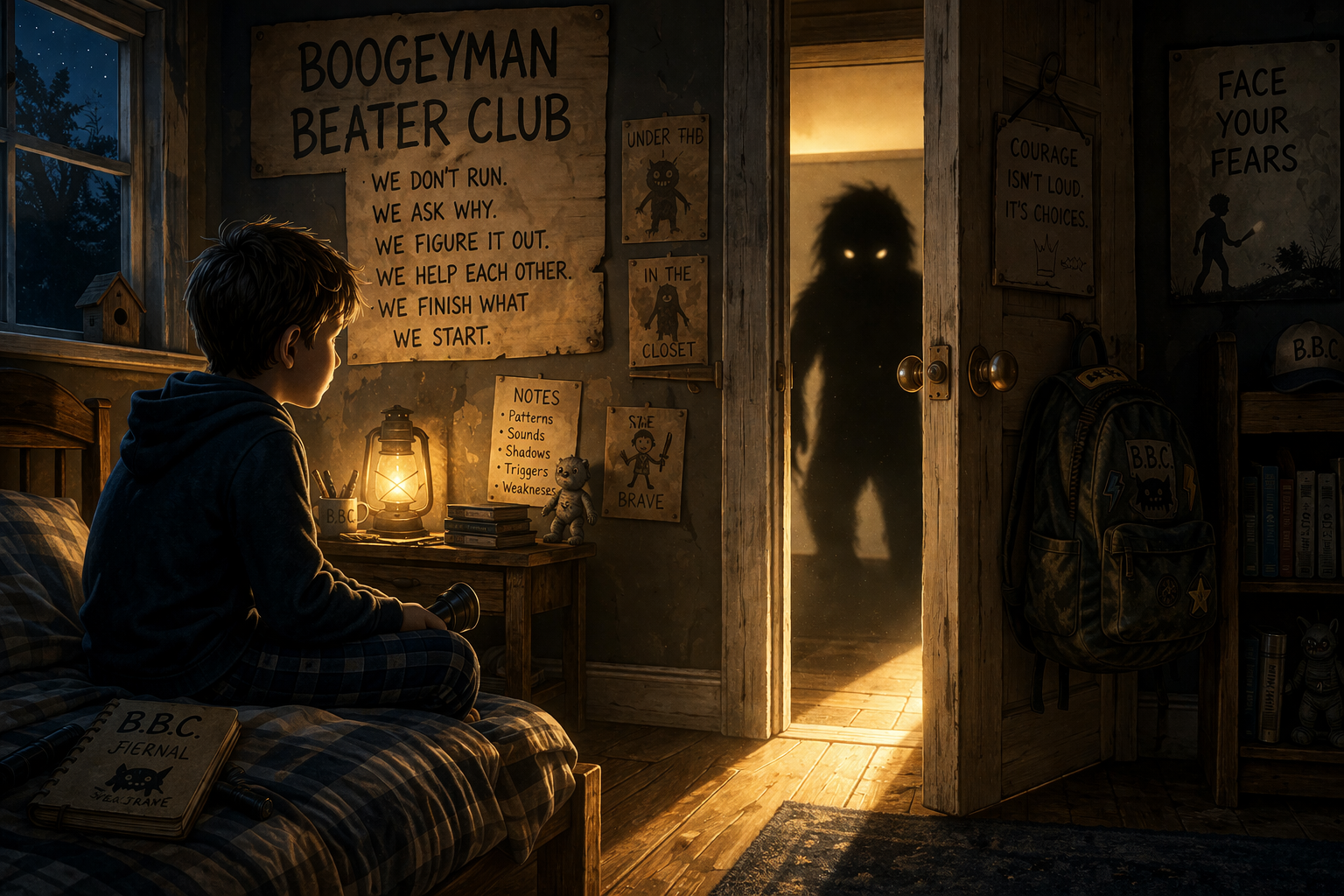
Pinned to the wall beside his bed was a worn piece of paper, its edges softened from time and handling. The words written across it were uneven but deliberate, marked with the kind of intention that comes from repetition. At the top, in thick strokes, it read: Boogeyman Beater Club. Beneath it, a set of rules. Simple. Direct. Unpolished. We don’t run. We ask why. We figure it out. We help each other. We finish what we start.
Eli looked at those words longer than he expected to. Then he looked back at the door. The light had not changed. It still felt wrong. Still waited.
The decision that followed was not dramatic. It did not arrive as a surge of courage or a sudden burst of confidence. It was quieter than that, almost unnoticed. A shift. A choice not to stay where he was. He swung his legs over the side of the bed and stood. The floor was cold beneath his feet, more noticeable now, as though every detail in the room had sharpened. He reached beneath the bed and found the flashlight, its surface scratched and worn from use. It was not perfect, but it worked. It had always worked. That was enough.
He moved toward the door slowly, each step deliberate. When his hand settled on the knob, he paused. This was the moment where everything could return to normal. He could turn back. Climb into bed. Let the night pass without interference. No one would know the difference. No one would see what he chose not to do. Except him.
The words came again, quiet but certain. We don’t run.
He turned the knob.
The hallway opened in front of him, stretching farther than it should have felt. The overhead light was still on, but it seemed weaker, unable to fully reach the corners it once filled. Halfway down the hall, something stood. It was not fully defined. Not entirely solid. Its shape shifted at the edges, as though it had not decided what it was meant to be. But it was there. Watching.
Eli did not step forward immediately. He did not retreat either. He stood in the doorway and observed, allowing the moment to exist without rushing it. This was another lesson the club had given him. Do not react before you understand. Let the fear reveal itself before you respond to it.
“What are you?” he asked, his voice steady despite the tension beneath it.
The thing did not answer, but it moved. Not toward him, not aggressively, but subtly, as if adjusting its position, testing its presence in the space. That movement was enough. It confirmed what he already knew. This was not nothing. This was something.
Eli raised the flashlight and turned it on. The beam cut through the dimness, landing directly on the shape. For a moment, there was no change. Then, just briefly, the figure flickered. It was small, easy to overlook, but it was real. And Eli saw it.
Something inside him shifted in response. Not fear disappearing, but clarity taking its place. The unknown had reacted. That meant it could be affected. That meant it was not untouchable.
“We ask why.”
He took a step forward.
The shape pulled back slightly. Not much, but enough to notice. Enough to matter.
Another step followed, slower, more certain than the last. “What do you want?” he asked.
There was still no answer, but the question changed the moment. It turned fear into something active, something he could engage with rather than endure. By the time he reached the middle of the hallway, he could feel the pressure building. The quiet suggestion to stop, to hesitate, to give space to the thing in front of him. That was how it worked. Not through force, but through doubt.
“We figure it out.”
Eli tightened his grip on the flashlight. “You don’t get to stay here,” he said, the words heavier now, more grounded.
This time, the reaction was clear. The figure shifted backward, pressing into the corner near the stairs. Its edges broke apart and reformed, less stable now, less certain of its own shape. Eli continued forward, not rushing, not forcing the moment, but holding his direction. The beam of light filled the space completely, leaving no shadow untouched.
The figure twisted, shrinking slightly, losing its definition with every second it remained exposed. Eli stopped a few steps away, holding his position. He did not attack. He did not try to destroy it. He simply stood there, present and unyielding.
And slowly, the figure began to fade.
Not disappear completely, not vanish in a dramatic instant, but weaken. Dissolve. Like something that could not maintain itself once it had been fully seen. The hallway returned to its normal state, the light stretching naturally once again, filling the space without resistance.
Eli remained still for a moment longer, ensuring the shift was real. Then he lowered the flashlight and turned back toward his room. The door remained open, wider now than before. Not halfway, not cautious, but fully.
The paper on the wall caught his attention again. The final line stood out in the quiet that followed. We finish what we start.
He climbed back into bed, placing the flashlight beside him. This time, he did not pull the covers over his head. He did not turn away from the open doorway. He simply lay there, looking into the hallway, not waiting for something to return, but no longer concerned if it did.
Because something had changed.
Not the house. Not the night.
Him.
The Boogeyman Beater Club had not taken away his fear. It had given him something better. The ability to face it. To understand it. To stand in its presence without surrendering to it. And sometimes, that is the difference between living with the door half closed and leaving it open without hesitation.
In that quiet, steady choice, fear begins to lose its power.