
The Boy Who Didn’t Run: Strength, Fear, and the Making of a Boogeyman Beater
There are moments in life that arrive without warning quiet, unannounced, and absolute. Moments when fear stops being something imagined and becomes something real. Not always in the form of a monster, not always something with claws and glowing eyes, but something just as powerful. Uncertainty. Doubt. The sense that you’ve stepped into something bigger than you are, something you don’t fully understand.
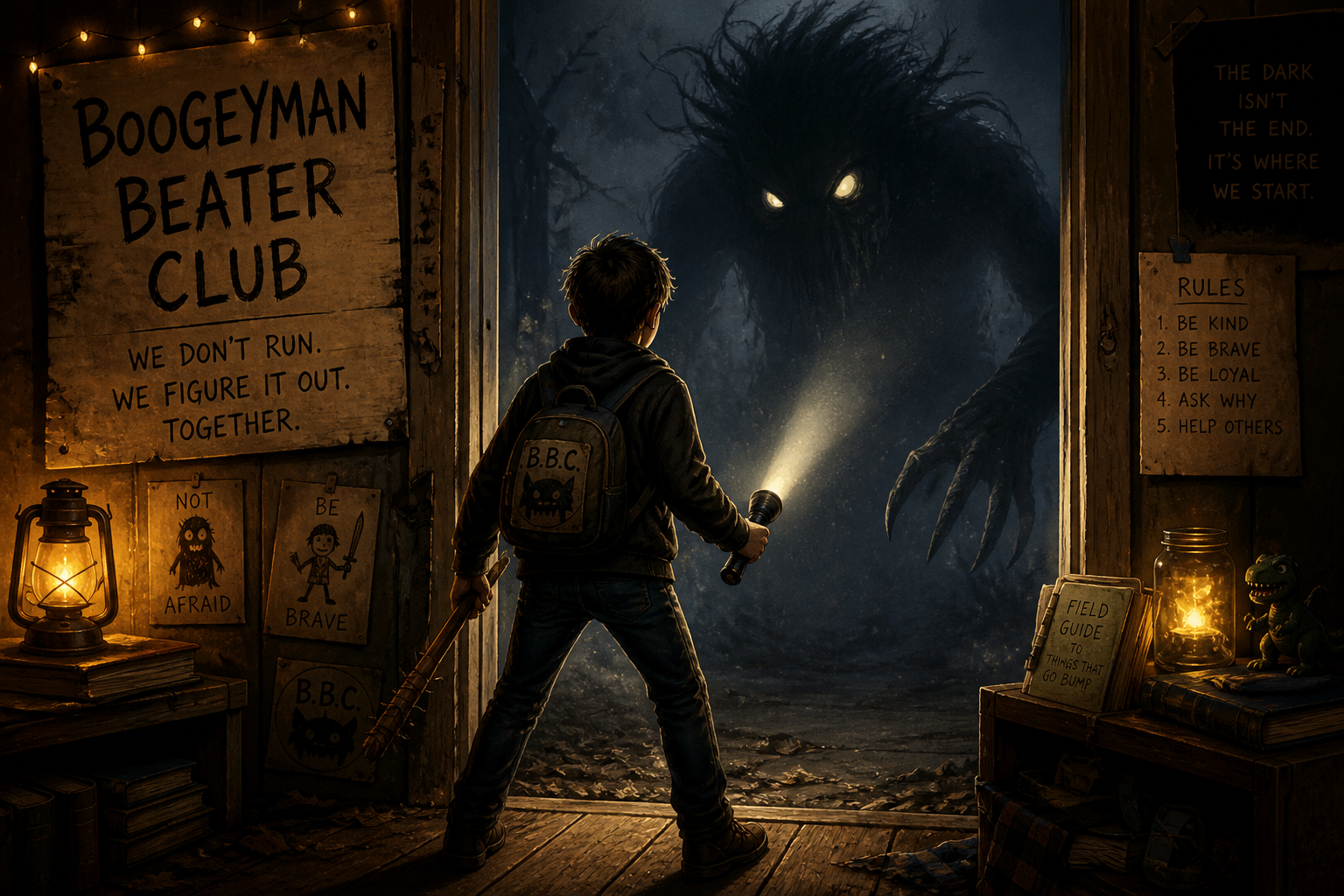
In this moment, though, fear has taken shape. It stands in front of the boy, towering and alive, something pulled straight from the darkest corners of imagination. It has presence. Weight. A stillness that feels intentional, as if it has all the time in the world. And yet, standing in the doorway between light and shadow, the boy does not run.
He isn’t dressed like a hero. There’s no armor, no badge of authority, nothing that signals power in the traditional sense. He is young, ordinary at first glance, holding a flashlight in one hand and a makeshift weapon in the other. On his back, stitched into his pack, are three simple letters: B.B.C. the Boogeyman Beater Club. That small detail carries more weight than anything else in the room, because what we are witnessing here is not a sudden act of bravery. It is the result of something built over time. Something learned, practiced, and reinforced long before this moment ever arrived.
Behind him, the room tells its own story. Lantern light flickers against rough wood and worn paper. Handwritten notes, sketches of strange creatures, and simple rules line the walls. This is not a place of perfection or polish. It is a place of process. A place where fear is studied instead of ignored, where the unknown is questioned instead of avoided. On one wall, written plainly, almost roughly, are the words: “We don’t run. We figure it out. Together.” It is less a slogan and more a foundation. A way of thinking that reshapes how fear is approached.
The Boogeyman Beater Club does not teach its members to pretend fear isn’t real. It does not offer easy comfort or empty reassurance. Instead, it teaches something far more enduring that fear is information, that the unknown can be explored, and that courage is not something you wait for but something you build. The boy standing in the doorway has internalized this. You can see it not in what he says, but in what he does not do. He does not step back. He does not turn away. He holds his ground.
The creature before him is not clearly defined, and that is precisely what makes it so powerful. It shifts at the edges, resisting full understanding. Its eyes glow, but its form feels unfinished, as though it is constantly changing, adapting to the fear directed toward it. This is the nature of the boogeyman. It is never just one thing. It is the accumulation of what we do not understand, the stories we tell ourselves when we lack answers, the shadows that grow in the absence of clarity.
For a brief moment, there is stillness. The kind that stretches time. The kind that allows doubt to enter quietly, almost politely. The thought that maybe this is too much. Maybe this is where it ends. That thought exists here, even if it isn’t spoken. It always does. But the difference in this moment is not the absence of fear it is the decision not to yield to it.
What the club has given the boy becomes clear in subtle ways. He has language for what he is facing. He may not understand every detail, but he is not encountering it blindly. He has seen sketches like this, heard stories like this, asked questions about things like this. The unknown, while still intimidating, is no longer completely foreign. He has tools not perfect ones, not guaranteed to work, but tools, nonetheless. The flashlight is more than a source of light. It is a means of focus, a way to direct attention and cut through uncertainty. Even the crude weapon in his other hand is not about dominance. It is about readiness, about refusing to stand unprepared.
More than anything, he has a framework to stand on. The rules posted on the wall be kind, be brave, be loyal, ask why, help others are not decorative. They are principles that shape action when instinct begins to falter. They provide structure when emotion threatens to take over. And perhaps most importantly, he carries with him the understanding that he is not truly alone. Every conversation, every shared moment within that clubroom, every lesson learned in smaller, safer situations, all of it stands with him now.
The creature moves, slowly, deliberately, as if testing the space between them. It does not rush. It does not need to. Fear rarely does. It lingers. It allows imagination to fill in the gaps. It waits for the person facing it to collapse under the weight of their own uncertainty. But that collapse does not come. The boy adjusts his stance, grounding himself, not advancing, but not retreating either. And in that quiet refusal, something shifts.
Strength, in this moment, is not loud or dramatic. It is not expressed through aggression or force. It is measured in stillness, in control, in the ability to remain present when everything inside you might be urging escape. The boy is not trying to destroy what stands before him. He is doing something more fundamental. He is refusing to be controlled by it.
Read or Explore More
👉 Discover more strange and unsettling stories:
https://theboogeymansclub.com
👉 Explore audiobooks and listen instead:
https://www.boogeymanbeater.com/audiobooks
Then, slowly and with intention, he raises the flashlight. The beam cuts through the dimness, landing directly on the creature. Light, in this context, is not just illumination it is exposure. It forces definition. It removes the comfort of ambiguity. And fear, at its core, relies on staying hidden, on remaining undefined and unchallenged. When the light meets it, the creature reacts. Not with a roar or an attack, but with something subtler. A flicker. A hesitation. A loss of certainty.
This is the turning point, though it may not look like one at first glance. The boy has not defeated the boogeyman in the way stories often suggest. There is no dramatic vanishing, no final blow that ends the confrontation completely. Instead, something more important has happened. He has proven that it can be faced. That it can be seen. That it does not hold absolute power.
The Boogeyman Beater Club was never about eliminating fear entirely. It was about changing the relationship to it. About turning something overwhelming into something understandable. About creating individuals who can stand in the presence of the unknown and choose not to retreat. That is what is being built here, not just in this moment, but in every moment that led up to it.
What unfolds in this image extends far beyond the scene itself. The boogeyman is not just a creature in the dark. It is a representation of everything people struggle to confront doubt, anxiety, the weight of uncertainty. And the boy represents something equally important: the possibility that those things can be faced with clarity and intention, not by ignoring them, but by engaging with them directly.
If the moment is frozen here, just before anything else unfolds, what remains is striking in its simplicity. A child stands in a doorway, caught between light and shadow. In front of him is something vast and uncertain. Behind him is everything he has learned, everything that has shaped him. And within him is a decision.
Not to run. Not to hide.
But to stand.
And in that decision, quiet and unassuming as it may seem, the balance shifts. Fear loses its certainty. The unknown begins to take form. And the boy, shaped by the lessons of the Boogeyman Beater Club, becomes something more than just a child in a doorway.
He becomes someone who can face what’s in front of him and that is where the real victory begins.